
Best Automatic Cat Feeders
A reliable default feeder with battery backup for a single cat, an RFID feeder that only opens for the cat wearing its tag in a multi-cat home, and a refrigerated feeder built specifically for wet food. Same job, feeding a cat on schedule, three different problems solved.
By Alex Rivera · Updated July 2026 · 6 min read
Written by a pet owner, not a content mill. For each pick I check the real product listing, materials and size, and recurring complaints in customer reviews where available, then name who it is not for. No brand pays me to rank picks. How I choose.
Quick answer
For most single-cat households, a straightforward feeder with a dependable timer and battery backup covers the job well, PETLIBRO's 3L feeder is a well-reviewed default with over 10,000 ratings. If more than one cat shares a feeding area and a faster eater keeps finishing a slower cat's portion, an RFID feeder that only opens for a specific collar tag solves that mechanically instead of relying on supervision. If you're feeding wet food instead of dry kibble, you need active refrigeration, a standard dry-food feeder isn't built to keep wet meals safe sitting out, and PETLIBRO's refrigerated feeder handles that specifically.
- Every automatic cat feeder does the same core job, scheduled dispensing, the real differences are battery backup, multi-cat recognition, and whether it handles wet food.
- An RFID feeder is a mechanical fix for food-stealing between cats, not just a scheduling app, but the included collar attachment is the weak point on the one here, budget for a sturdier ring.
- Wet food needs active refrigeration to stay safe sitting out for hours, a standard dry-kibble feeder isn't built for it.
- Battery backup matters more than it sounds, a feeder without it just stops feeding during a power outage.
This guide contains affiliate links. As an Amazon Associate we earn from qualifying purchases. See our disclosure.
An automatic cat feeder solves the same basic problem regardless of price: it dispenses a set portion of food on a schedule so your cat gets fed on time even when you're not home to do it by hand. Past that shared core, the real differences show up in the details that actually matter for a cat household specifically, whether the feeder has backup power for an outage, whether it can tell one cat's portion from another's, and whether it's built for dry kibble or wet food.
We picked three that cover the real, distinct reasons a cat owner searches for one of these: a solid, well-reviewed default for a single cat, RFID recognition for a household where cats need different diets or portions, and active refrigeration for wet food. Match the pick to your actual household. If you're feeding a large dog instead, or want a feeder with a built-in camera, see our full automatic pet feeders guide, which covers those cases too. Whatever feeder you pick, a pet food storage container keeps the bag you're loading it from fresh.
PETLIBRO Automatic Cat Feeder (3L)
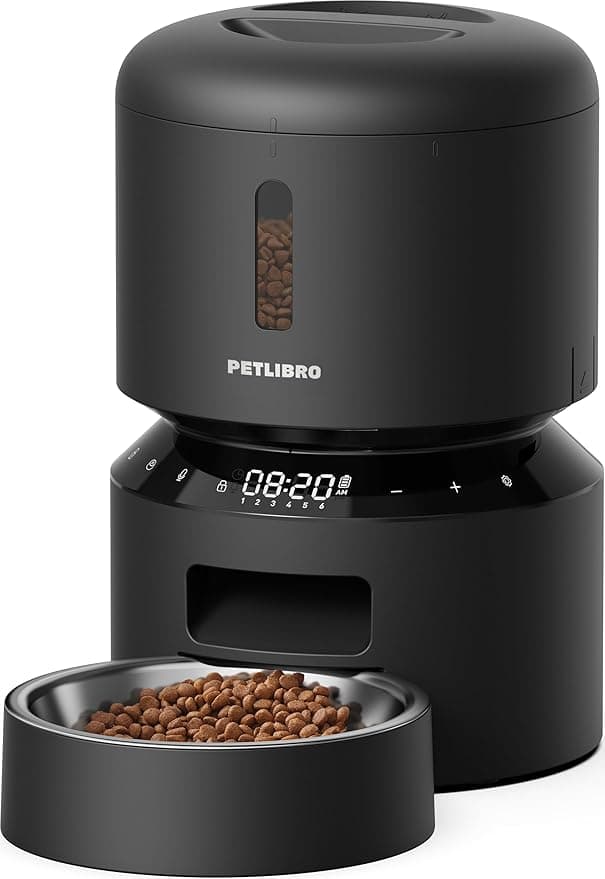
PETLIBRO 3L feeder with battery backup, up to 6 scheduled meals a day.
See pricePETLIBRO RFID Automatic Cat Feeder
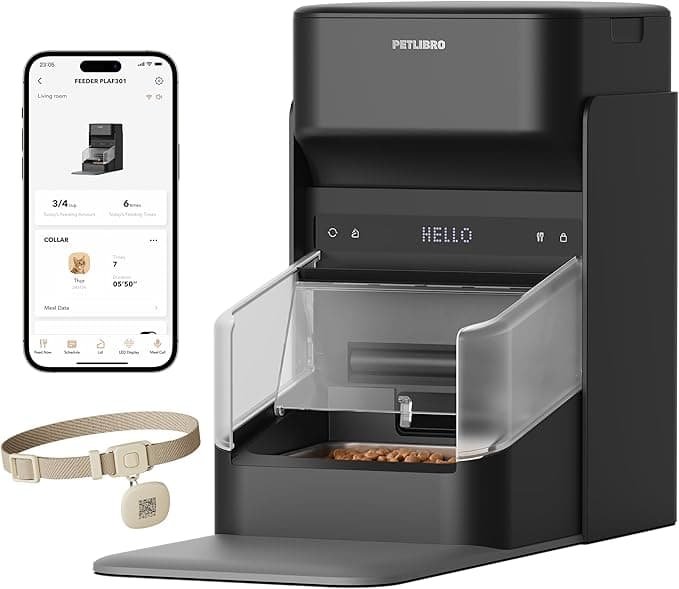
PETLIBRO RFID feeder: collar-tag recognition stops one cat from eating another's portion.
See price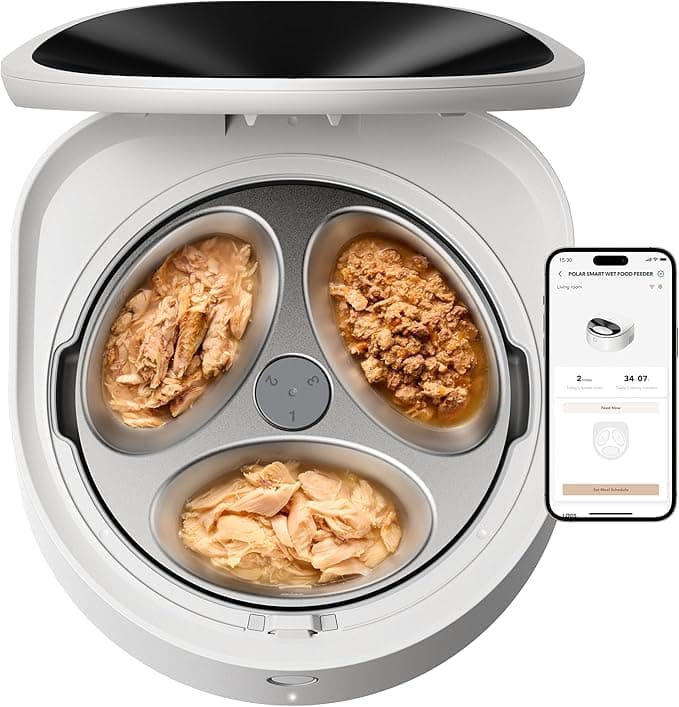
PETLIBRO Refrigerated Wet Food Feeder
PETLIBRO Refrigerated feeder: semiconductor cooling keeps wet meals fresh for up to 3 days.
See priceCompare our picks
| Item | Best for | Price | Bottom line | |
|---|---|---|---|---|
| ★ PETLIBRO Automatic Cat Feeder (3L) | Best Overall | $$ | For its core job, timed, portion-consistent dry kibble feeding with a battery backup that holds up under a real outage test, this feeder delivers reliably; the tradeoffs are a genuinely loud programming process and a couple of minor physical annoyances rather than any dispensing failure. Whatever feeder you pick, a pet food storage container keeps the bag you're loading it from fresh. | See price |
| PETLIBRO RFID Automatic Cat Feeder | Best for Multiple Cats | $$$ | This one earns its higher price by doing what it claims, the RFID-gated lid genuinely stops food-stealing in multi-cat homes, and the eating-history log is a real, useful record. The weak link isn't the feeder itself but the included collar attachment, budget for a sturdier ring or fob mount from day one rather than treating the stock collar as final. For more on feeding setups across multiple pets, see our pet feeders guide. Whatever feeder you land on, our pet food storage containers guide is worth a look too, an airtight container keeps the kibble a feeder like this dispenses fresh. | See price |
| PETLIBRO Refrigerated Wet Food Feeder | Best for Wet Food | $$$ | The core promise holds up, multiple independent reviewers confirm the cooling keeps wet food fresh and appropriately cool through a full day, which is the whole reason to pick a refrigerated feeder over a plain automatic one. The real risk isn't food temperature, it's app and sensor reliability, where a minority of owners hit sync failures or a stuck tray motor and got little help from support. For dry storage between meals, see our pet food storage containers guide. | See price |
Default, multi-cat, or wet food: what actually differs
The default pick and the RFID feeder both handle dry kibble the same basic way, a hopper and a scheduled dispensing mechanism, the RFID version just adds a collar-tag lock so it only opens for the cat it's assigned to. That's a real mechanical fix for a multi-cat household where one cat keeps finishing another's portion, not just a scheduling feature.
The refrigerated feeder solves a different problem entirely. Dry kibble sits fine at room temperature between meals, wet food doesn't, so it uses semiconductor cooling to keep pre-portioned wet meals cold until it's time to serve. If you're feeding wet food, none of the dry-kibble feeders are built to do this safely.
- All three include app-based scheduling, the differences are in recognition, refrigeration, and battery backup
- The RFID feeder only works with its included collar tag, no phone-based or collarless recognition
- Only the refrigerated feeder handles wet food safely, the other two are built for dry kibble only
- Battery backup on the default and RFID feeders keeps them dispensing through a power outage
Confirm any collar tag is a genuine breakaway fit before leaving a cat unsupervised with it on, and check in during the first few days. One reviewer of the RFID feeder here reported a collar-related choking incident.
Best overall: PETLIBRO 3L Automatic Cat Feeder
This is who it's for: a single cat, or a cat and a small dog, on a regular dry-kibble schedule, where a dependable timer and backup power matter more than extra recognition features.
Who should skip it: a household with more than one cat sharing a feeding area, or anyone feeding wet food, the two picks below solve those specific problems.
PETLIBRO Automatic Cat Feeder (3L)
A 3L automatic feeder with up to 6 scheduled meals a day, an airtight lid, and battery backup for power outages. #2 in Small Animal Automatic Feeders, 10,000+ ratings.
Best for multiple cats: PETLIBRO RFID Automatic Cat Feeder
This is who it's for: a household where more than one cat shares a feeding area and a faster or bolder eater keeps finishing a slower cat's portion too. A collar-mounted RFID tag opens the lid only for the cat it's assigned to.
Who should skip it: a single-cat household, where the RFID recognition solves a problem that doesn't exist yet. The default pick above does the same core job for less complexity and cost.
PETLIBRO RFID Automatic Cat Feeder
An RFID-recognition feeder that only opens for the cat wearing its assigned collar tag, with a bowl shield and app-based eating logs. 19,000+ ratings, the most reviewed pick in this lineup.
Best for wet food: PETLIBRO Refrigerated Feeder
This is who it's for: anyone feeding wet food instead of dry kibble, where a standard feeder isn't built to keep meals safe sitting out for hours.
Who should skip it: anyone feeding dry kibble only, the active refrigeration here is solving a problem you don't have. Either pick above handles dry food fine.
PETLIBRO Refrigerated Wet Food Feeder
A refrigerated feeder holding 3 pre-portioned wet meals, cooled for up to 72 hours, with a single-piece stainless steel bowl. 860+ ratings.
Compare the three at a glance
The short version: the default pick for a single cat on dry kibble, the RFID feeder for a multi-cat household, and the refrigerated feeder for wet food.
| Cat feeder | Best for | Recognition | Price |
|---|---|---|---|
| PETLIBRO 3L | Single cat, dry kibble | None | $$ |
| PETLIBRO RFID | Multi-cat households | RFID collar tag | $$$ |
| PETLIBRO Refrigerated | Wet food | None | $$$ |
Prices vary by size, color, and current Amazon promotions. Check the real price on each product page before buying, we don't display fixed prices here.
Frequently asked questions
What is the best automatic cat feeder?
For most single-cat households, a straightforward feeder with a dependable timer and battery backup covers the job well. If more than one cat shares a feeding area, an RFID feeder that only opens for a specific collar tag stops food-stealing. If you're feeding wet food, you need one with active refrigeration.
Can one automatic feeder work for multiple cats?
A basic feeder works fine if your cats already eat calmly from the same bowl. If one cat tends to eat another's portion, an RFID-recognition feeder that only opens for a specific collar tag solves that directly.
Do automatic cat feeders work with wet food?
Only feeders specifically built for it. Standard dry-kibble feeders aren't refrigerated, so wet food left in them can spoil sitting out. Look for a feeder with active cooling if wet food is what you're feeding.
What happens to an automatic cat feeder during a power outage?
It depends on the model. The default and RFID picks here both include battery backup that keeps the schedule running through an outage. Check for battery backup specifically if outages are a real concern where you live.
Is the RFID collar tag safe for my cat?
Confirm it's a genuine breakaway fit and supervise your cat during the first few days wearing it, same as you would with any new collar attachment. At least one reviewer of the RFID feeder reported a collar-related choking incident, so this is worth checking rather than assuming.