Interactive & Automatic Cat Toys
Interactive Cat Toys: What Actually Gets a Bored Cat to Play
Motion, scent, and texture are what pull a bored cat back to a toy, not the price tag or the packaging. Here's what actually works, and why not every cat cares about catnip.
By Alex Rivera · Updated October 2026 · 7 min read
Written by a pet owner, not a content mill. For each pick I check the real product listing, materials and size, and recurring complaints in customer reviews where available, then name who it is not for. No brand pays me to rank picks. How I choose.
Quick answer
For most bored indoor cats, the interactive toys that actually get used are self-moving or catnip-scented ones, because motion and scent are what pull a cat back after the first day. A toy that reacts to touch, spins, or dispenses food tends to hold attention longer than one that just sits still. Expect some cats to ignore anything motorized, and pair a solo toy with hands-on wand play for real chase-and-catch time.
- Motion, scent, and reactivity are what keep a bored cat coming back.
- Self-moving and catnip toys work solo; wand toys need you on the other end.
- Some cats ignore motorized toys entirely. That is normal, not a defect.
Most cats ignore most toys after the first day. "Interactive" gets stamped on everything from a basic mouse to an expensive robot, but what actually gets used on a bored cat comes down to three things: motion, scent, and whether the toy does something back when your cat engages with it.
Interactive cat toys work through a few different mechanisms. Most are solo toys that create their own motion, scent, or challenge without a person holding anything: a catnip-scented plush, a mounted toy with a spinning light, a turntable, a puzzle box, a food dispenser, and automatic balls all fall into that category. A wand toy is the exception, it needs a person on the other end for chase play.
What actually makes a cat engage with a toy
Three things matter more than the toy's price or how it looks in photos: motion, scent, and texture. Motion mimics prey, a sudden flap or a spinning light triggers the same instinct as a bird or a bug moving in the grass. Scent, mainly catnip, pulls a cat toward a toy it might otherwise walk past. Texture matters once the cat is engaged: something soft enough to bite and kick holds attention longer than hard plastic.
Not every cat responds to catnip. Some cats simply don't react to it at all. If your cat is one of them, motion and texture are doing all the work, and a catnip pocket is just a bonus feature, not a guarantee the toy gets used.
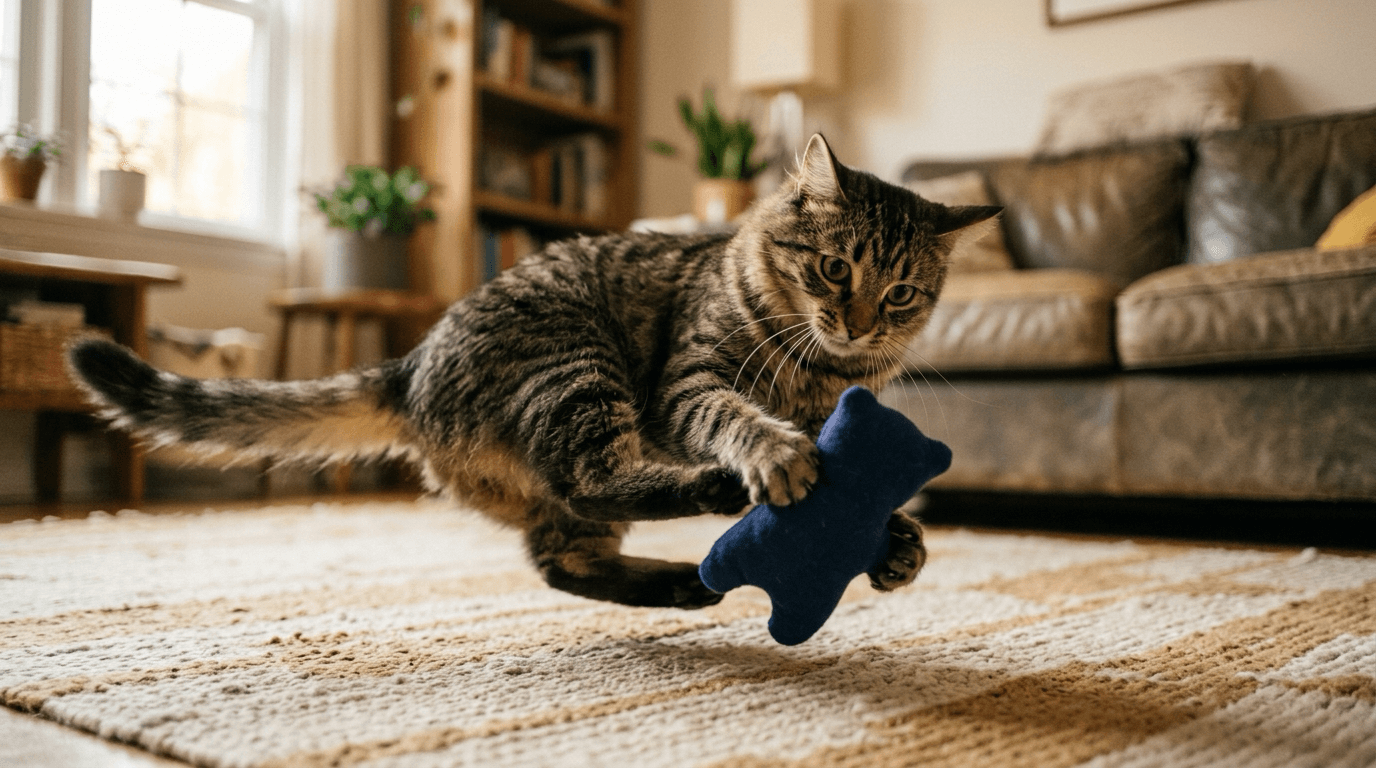
Owner-driven play vs. solo play
Wand toys need a human on the other end, you're the one creating the motion, and that's a real form of play a cat can't replicate alone. Solo toys, catnip plush toys, mounted spinners, puzzle boxes, food dispensers, and automatic balls, are a different category: they create their own motion, scent, or challenge without you holding anything. That makes them useful for the hours you're not home, but it doesn't replace wand play. A cat that only ever gets a solo toy and never gets chased-the-string time with you is still an under-stimulated cat.
"Interactive" on the package means the toy reacts to touch or moves on its own, not that it's a substitute for you playing with your cat.
A safety note on battery-powered toys
Many solo interactive toys, especially ones with a flapping or spinning motion, are battery-powered or rechargeable. Check that the battery compartment is fully closed and screwed shut before handing a new toy to your cat, and supervise the first few sessions with any battery-powered toy so you can see how your specific cat interacts with it, some cats chew at seams or compartments more than others.
- Confirm the battery compartment is closed and secured before first use
- Supervise the first few play sessions with any new battery-powered toy
- Stop use and check the toy if the compartment seal looks worn or loose
Types of interactive cat toys to consider
Different cats respond to different mechanisms. A few common types to look for:
- Catnip-scented plush toys: soft enough to grab and kick, good for a cat with the classic "bunny kick" pounce reaction.
- Motion toys: a spinning light, a flapping motion, or an automatic ball, for a cat that responds to movement more than scent, and useful for hands-free, solo play.
- Puzzle boxes: a wand or ball tucked into an enclosed box, for a cat that gets bored of simple motion and does better working a mechanism to get a reaction out of it.
- Food-puzzle dispensers: turn a treat or a portion of kibble into a game, for a food-motivated cat. These are not food or health products, just a shape that makes snack time take more work.
- Wand toys: the one style of play a solo toy can't replace, since it needs a person on the other end for real chase-and-catch play.
- Multi-cat toys: designs like a multi-track turntable that give more than one cat something to bat at the same time, instead of competing over a single toy.
Frequently asked questions
Are food-puzzle cat toys a food or health product?
No. They're a shape that turns a snack or a portion of kibble into a puzzle, they don't add or change what your cat eats.
What's the difference between automatic ball toys and wand toys?
Automatic balls move on their own with no human needed, good for the hours you're not home. Wand toys only work with you holding them, but they give your cat real chase-and-catch play a solo toy can't replicate.
Will my cat actually respond to catnip toys?
Not necessarily. Catnip sensitivity is inherited, and roughly a third of cats don't react to it at all. Motion-based solo toys, a flapping motion or a spinning light, still work for a cat that ignores catnip entirely.
Do interactive toys replace playing with my cat?
Solo toys, ones that create their own motion or challenge, are useful for the hours you're not around, but they're not a full substitute. A wand toy is the one built for you to hold, for the chase-the-string time only a person can give a cat.
Is a wand toy safe to leave with my cat unsupervised?
No. Wand toys have a string and small feather parts, so they're meant for supervised play, not something to leave in a cat's reach when you're not around.