Scratching & Climbing
Cat Scratching Posts and Cat Trees: What Actually Gets Used
Material, angle, and stability decide whether a cat picks the scratcher over the couch, not price. Here's what actually matters, and the types worth considering.
By Alex Rivera · Updated October 2026 · 7 min read
Written by a pet owner, not a content mill. For each pick I check the real product listing, materials and size, and recurring complaints in customer reviews where available, then name who it is not for. No brand pays me to rank picks. How I choose.
Quick answer
For most cats, the scratching post that actually gets used instead of the couch is a tall, sturdy, sisal-wrapped one, because material, angle, and stability matter more than price. A heavier base suits a big cat, a compact tower suits a kitten or a small room, and a flat board suits a cat that scratches horizontally.
- Material, angle, and stability decide whether a post beats the couch, not price.
- Sisal, tall enough for a full stretch, on a base that does not wobble gets used most.
- Match height and base weight to your cat's size; add a flat board for horizontal scratchers.
A cardboard scratcher from the pet aisle gets used for a week, then sits ignored while your cat goes back to the couch arm. What keeps a cat coming back to a scratcher instead of the furniture comes down to material, angle, and stability, not price.
Scratching posts and cat trees solve different problems depending on your space and your cat. Full climbing pieces, compact towers sized for small rooms and kittens, taller multi-step trees, and stair designs, give a cat somewhere to climb as well as scratch. Standalone scratchers, flat scratching boards, and scratcher sofas cover a second spot in another room without the footprint of a full tree. None of these are health or behavior products, they're furniture built to give scratching and climbing an outlet as good as the couch, or better.
Why cats scratch furniture instead of a scratcher
Scratching does two things for a cat: it keeps the outer layer of the claw in condition, and it gives them a way to stretch through the shoulders and back. It's not optional behavior, so if a scratcher isn't nearby or isn't appealing, the couch becomes the default target.
Whether a cat picks the scratcher over the furniture usually comes down to three things: what it's covered in, how it's angled, and whether it wobbles when they lean into it.
What actually makes a scratcher get used, not ignored
Material matters most: sisal rope or sisal fabric is the surface to look for over cardboard or carpet, and many cats like scratching it. Stability matters almost as much, since a post that wobbles on the first try may get ignored.
- Sisal rope or sisal fabric is the surface to look for over cardboard and carpet for daily scratching
- A stable, weighted base matters as much as the material, a wobbly post gets one try
- Vertical posts suit cats that like to stretch tall, low or angled surfaces suit cats that scratch closer to the ground
- Placement matters: a scratcher tucked in a back room gets skipped in favor of whatever furniture is closest
Put a new scratcher near whatever your cat already scratches, not in a separate room. Location beats novelty for getting it used in the first week.
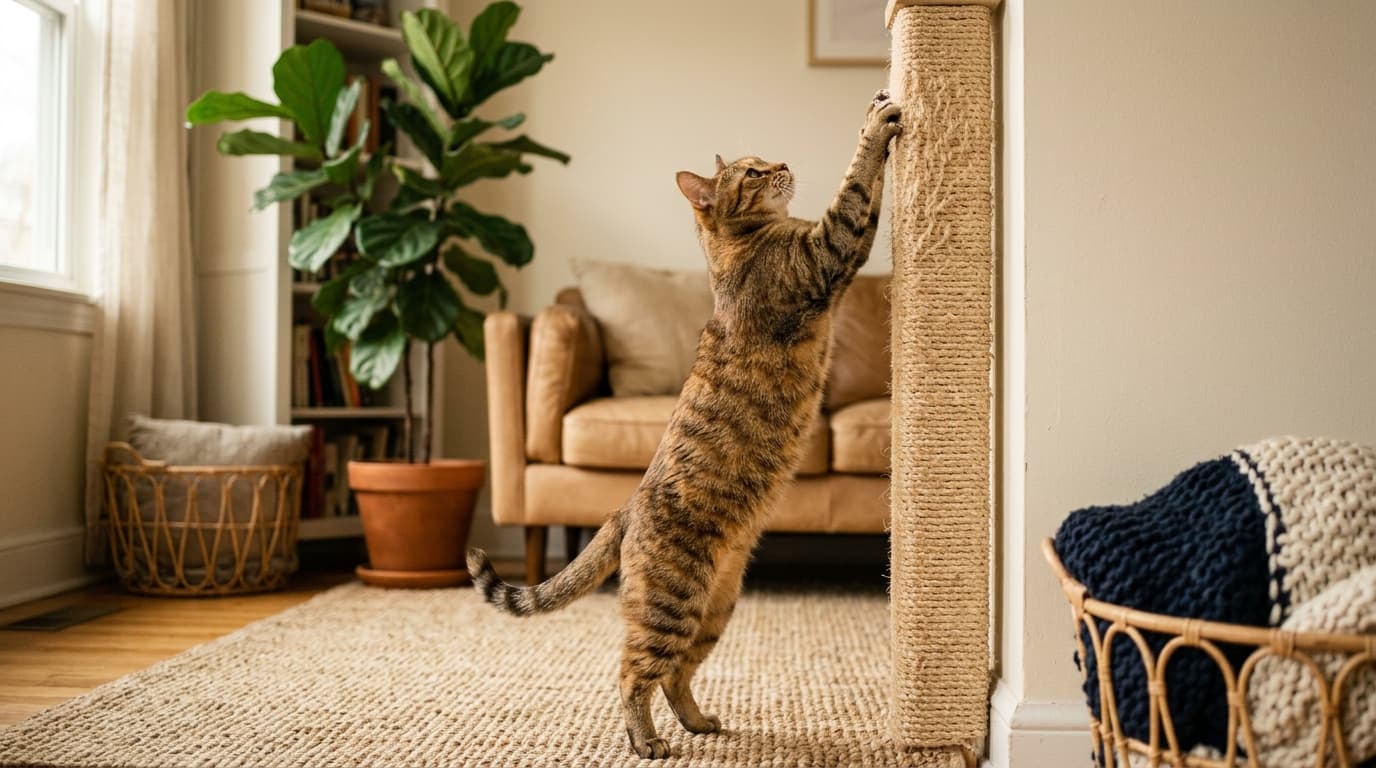
Types of scratching posts and cat trees to consider
Space, budget, and how your cat likes to scratch all point toward a different type:
- Compact towers: a smaller sisal post combined with a perch, sized to fit a corner without taking over the room, good for small spaces and kittens.
- Multi-step trees and stairs: taller pieces with a sisal post built into each level, useful for a cat that already jumps for a bed, sofa, or windowsill and needs a safer route up.
- Standalone sisal scratchers: just a scratching post for a second spot in another room, without the height or footprint of a full tree.
- Flat scratching boards: a horizontal surface for a cat that scratches low, along the floor or a rug, instead of stretching up a vertical post.
- Scratcher-and-bed combos: a resting area with a sisal scratch panel built into the base, for a cat that wants to scratch and nap in the same spot.
- Scratcher sofas: novelty-shaped, wood-framed scratchers that double as a resting spot, mostly a design choice over the plainer standalone posts.
Frequently asked questions
What's the cheapest way to add a scratcher without buying a full cat tree?
A standalone sisal scratching post is usually the lowest-priced way to add a spot without a full cat tree. A scratcher with a resting bed or a novelty shape built in costs more but adds a resting spot or a design element.
Will a scratching post stop my cat from scratching the couch entirely?
Not automatically. Placement matters as much as the product: put it where your cat already scratches, not tucked in a back room, and give it a few days before deciding it isn't working.
Which type should I get for a large-breed cat, like a Maine Coon?
Look for a cat tree or scratcher with more room per level and a wider, heavier base. A perch sized mainly for kittens and average-size cats can be outgrown by a large adult cat, so size up rather than default to the smallest or cheapest option.
Do cat trees wobble under a full-grown cat?
It depends on the base weight and construction, so check the weight rating and reviews before buying. A post or tree that wobbles under a full-grown cat tends to get abandoned fast, so stability is worth checking before height or extra features.
Do I need more than one scratcher if I have multiple cats?
Often, yes. A single scratcher can mean competition for it in a multi-cat household, so consider one scratcher per cat, or one per main room.