Dog Puzzles & Enrichment
Slow Feeder Dog Bowls: How to Choose One
A maze pattern, a puzzle layout, or a lick mat all slow down a fast eater in a different way. Here's how each one works and how to tell which fits your dog.
By Alex Rivera · Updated October 2026 · 5 min read
Written by a pet owner, not a content mill. For each pick I check the real product listing, materials and size, and recurring complaints in customer reviews where available, then name who it is not for. No brand pays me to rank picks. How I choose.
Quick answer
A slow feeder dog bowl uses raised ridges or a maze pattern to force a dog to eat around obstacles instead of inhaling food in one pass, turning a minute-long meal into several minutes. Fast eaters, multi-dog households, and dogs that gulp and act hungry again right away benefit most; a dog that already eats at a normal pace doesn't need one.
- Maze-pattern bowls slow down fast eaters by making them work around raised ridges instead of eating in one pass.
- Puzzle-style feeders add more resistance than a simple maze, for dogs that need mental work, not just pacing.
- A lick mat or treat dispenser can slow down a meal or treat time without using a rigid bowl shape.
- Not for calm eaters: a slow feeder does nothing for a dog that already paces itself.
- These pace out a meal. They are not a food or health product.
A dog that empties its bowl in under a minute isn't just messy about it, it's gulping air along with the food. A slow feeder bowl doesn't change what your dog eats, it changes how fast they can eat it: raised ridges and maze patterns force them to work around obstacles instead of inhaling everything in one pass.
Slow feeders come in a few different shapes built for different dogs. A simple maze pattern is the most common and the easiest place to start. A puzzle-style bowl adds more resistance for a dog that needs mental work along with pacing. Some feeders skip the bowl shape entirely, using a lick mat or a treat dispenser instead, for dogs that do better with something that isn't rigid. None of these are food or health products: they're shapes that pace out a meal, nothing more.
How a slow feeder bowl actually works
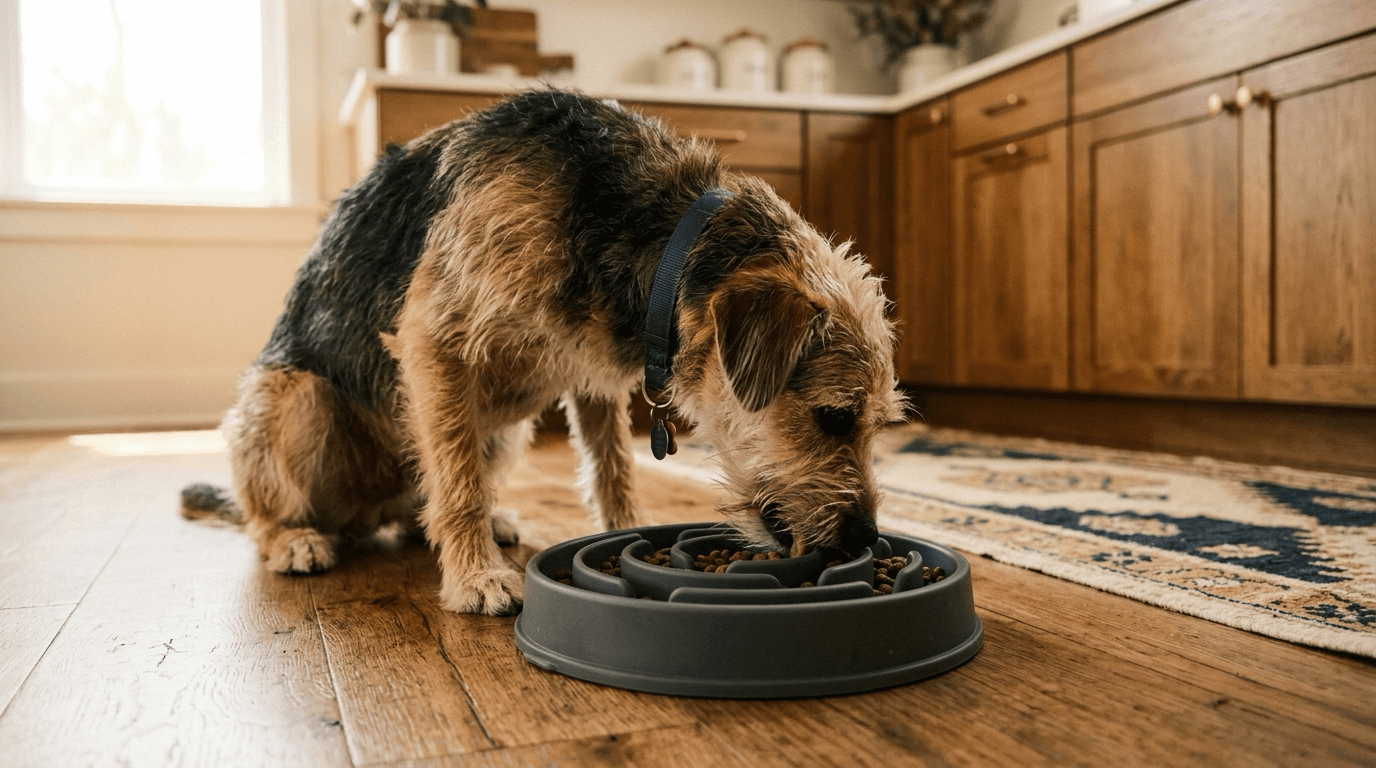
The mechanism is simple: raised ridges, walls, or a maze pattern break up the bottom of the bowl so your dog can't just put their face down and inhale everything in one motion. They have to nose around the pattern to get each bite, which stretches a one-minute meal into five or ten.
That's the whole trick. No food additive, no supplement, just a different bowl shape. If your dog treats every meal like a race, a slow feeder is a mechanical fix, not a dietary one.
Who actually needs one
Fast eaters are the obvious case: if your dog finishes a bowl in under a minute and looks up for more immediately, a slow feeder is worth trying. Multi-dog households also benefit, since a dog eating fast next to a competing dog tends to eat even faster.
- Dogs that finish a normal bowl in under a minute
- Dogs that gulp and then act hungry again right away
- Multi-dog households where one dog rushes to beat the other
- Dogs that get restless or pace right after eating
Gentle, slow eaters don't need this. If your dog already takes their time with a normal bowl, save the money for something else.
What to look for in a slow feeder bowl
Not every slow feeder is built the same way, and the right one depends on how determined a gulper your dog is and how much mental work you want built into mealtime.
- A non-slip base, so the bowl doesn't slide across the floor while your dog noses at the pattern
- Bowl depth and pattern height matched to how fast your dog eats: deeper ridges mean a slower meal
- Bowl size matched to your dog's size: small and medium dogs generally need a smaller bowl, medium and large dogs need more surface area to get real resistance
- Food-safe, easy-to-clean material, since ridges catch more residue than a flat bowl
- A suction-cup lick mat if you want something that sticks to a bowl, wall, or floor instead of a rigid bowl shape
How to choose the right type
A simple maze pattern is the easiest place to start: it works for most dogs that just eat too fast, and it's usually the cheapest option. Look for a size that matches your dog, a smaller bowl for small and medium dogs, and a wider, deeper design for medium and large breeds that need more resistance to actually slow down.
If your dog needs more than pacing, a puzzle-style feeder adds extra resistance and redirection, closer to a treat puzzle than a basic maze. A lick mat or treat dispenser can suit a dog that does better with something that isn't a rigid bowl, or can be used to slow down treat time specifically instead of a full meal.
Frequently asked questions
Is there an option for a dog that needs mental work, not just slower eating?
Yes. Puzzle-style feeders add more resistance and redirection than a simple maze, closer to a puzzle than a basic slow feeder. Look for one if your dog needs to work for each bite, not just eat a bit slower.
Will this work for a puppy or a large breed?
Many slow feeders are sized specifically for medium and large dogs, so check the dimensions before buying. For a small dog or a puppy, a simpler maze-pattern bowl in a smaller size is usually the better fit.
Can I use a slow feeder bowl with wet food?
Most slow feeder bowls are built with kibble in mind. Wet food tends to pool in the ridges instead of catching the way dry kibble does, so if your dog eats wet food, a lick mat is usually a better fit than a bowl.
Are slow feeder bowls dishwasher safe?
It depends on the material and the manufacturer's instructions, so check the product listing or packaging before assuming. When in doubt, hand-wash to be safe.
Does a slow feeder bowl change what my dog eats?
No. A slow feeder doesn't change what your dog eats, only the pace: the maze, puzzle, and dispenser shapes just make each bite take more work.